
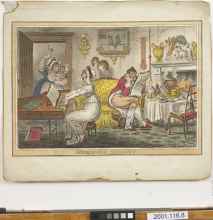
Matrimonial--Harmonics
Image Item
Description
This image depicts the failure of harmony in the marriage previously represented (in its partner print) as a harmonious courtship. Harmony is used as a visual pun in each print to convey first, the appealing fantasy of romance, and then the harsh reality of a marriage originating in such a fantasy.
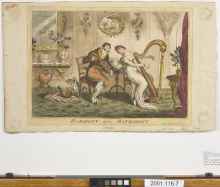
Harmony Before Matrimony
Image Item
Description
This image depicts courtship as typically conceived by the Romantic imagination, as a moment of finding or establishing figurative harmony; such a moment or situation was dependent on the prior, elegant education of young ladies in certain, socially-mediating arts.
Physiological Disquisitions, Plate IV
Image Item

Description
This image visually depicts the working of sound using the Aeolian harp—an instrument significant to the Romantic imagination—as the primary model. The engraving also includes several scientific diagrams indicating how the harp might function.
Treatise on Sound, Plate 3
Image Item

Description
This scientific diagrams depicts "vibrations in solid bodies," including rods and plates. In the image, Herschel presents readers with another set of experiments that helps them conceptualize the movement of sound through space, again depending on the visual. Figures 36-41 involve the vibrations of a rod either resting against a wall or free.
Outlines of Experiments and Inquiries Respecting Sound and Light, Plate VII
Image Item

Description
This image depicts an octave as rendered differently by each temperament. Young particularly emphasizes circumference Y, which represents the system that Young found most effective: twelve-tone equal temperament. The image depicts an octave and variant systems of tuning, or "temperament." The octave is represented by the circumference of the circle.
Outlines of Experiments and Inquiries Respecting Sound and Light, Plate VI
Image Item

Description
Using mathematical techniques, this image visually depicts aural phenomena: the sound waves produced by playing an octave. The image uses scientific diagrams to depict sound waves and vibrational patterns. The specific phenomena depicted by the various figures and the import of these depictions are discussed at length below.
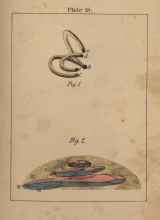
The Organs of the Senses Familiarly Described, Plate 18
Image Item
Description
The series of plates given in this gallery depicts the ear and how it works. This image, Plate 18 of Bell's illustrations, depicts the semicircular canals of the ear. Bell further describes the image: "The cochlea is named by its similitude to the shell of a snail. It is the most difficult part of the ear to be described."
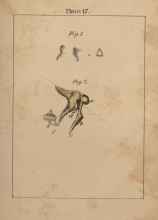
The Organs of the Senses Familiarly Described, Plate 17
Image Item
Description
The series of plates given in this gallery depicts the ear and how it works. This image, Plate 17 of Bell's illustrations, depicts the three small bones of the ear. Bell describes it as such: