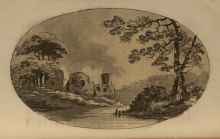
Grand Woody Banks near Ross-on-Wye
Grand Woody Banks near Ross-on-Wye was originally sketched in the travel journal of William Gilpin. This and other sketches were eventually published in the printed version of Gilpin’s journal.
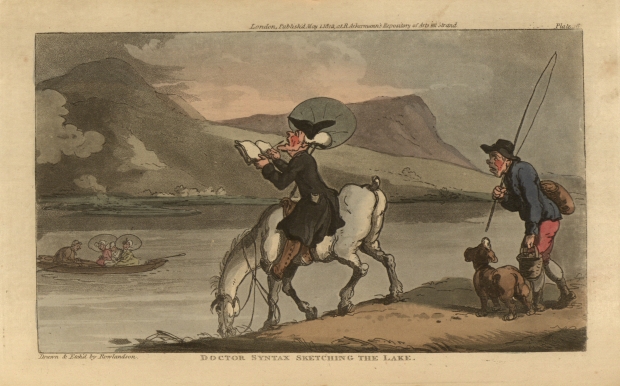
“Start hence with us, and trace, with raptur’d eye, / The wild meanderings of the beauteous WYE; / Thy ten days leisure ten days joy shall prove, / And rock and stream breathe amity and love” (see Robert Bloomfield's poem, The Banks of Wye
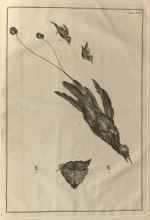
As Judith Pascoe argues in her 2006 book The Hummingbird Cabinet: A Rare and Curious History of Romantic Collectors, “[t]o be a collector of hummingbirds in the romantic period was to experience the most inspirational collecting conditions: a seemingly endless supply of new types of birds, each potentially lovelier than the last” (27).
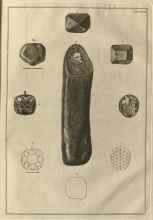
While the title of this plate, “Governor Pitt’s Brilliant Diamond, &c,” gives the impression of a series of objects of great value, it is worth noting that none of the drawings are of actual diamonds; they are based instead on “models” and “diagrams” of privately owned diamonds.
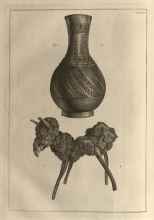
It is difficult to discern a rationale for the Rymsdyks’ decision to associate these two drawings and thus, to discern these two objects from the collections of the British Museum.
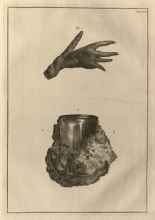
Although the two drawings on this plate clearly unite objects from different categories of the British Museum’s collections—the vessel in Figure 1 is man-made, an artificial production, while the lamb in Figure 2 appears to be a product of nature—the so-called “Scythian lamb” further confuses the classificatory boundaries that the associations between the artifacts in Rymsdyk’s drawings c
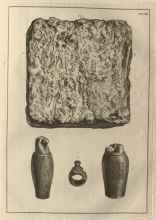
What is perhaps most remarkable about this illustration from the Rymsdyks’ Museum Britannicum is how unremarkable the most prominent drawing actually is: Figure 1, the square brick which dominates the upper half of the plate, is drawn with the same meticulous attention to detail that Rymsdyk devotes to the most complex of forms, yet it hardly seems to warrant this de
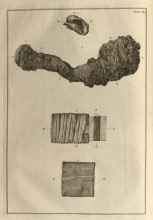
While a number of the Rymsdyks' illustrations in Museum Britannicum are visually sparse in terms of the number of specimens depicted and the scale by which they are rendered, this particular plate is replete with four figures that fill almost all of the available space.
Among the vast collection of “Sloaniana” in the British Museum, 756 examples of “humana, as calculi, anatomical preparations, &c” were recorded in “An Account of the British Museum,” published in The New London Magazinein July 1788 (378).