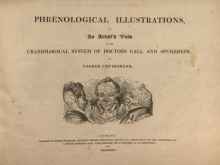
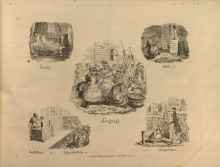
Title Image
The mapped head was associated with phrenology from its earliest publications throughout the nineteenth century. It provided a useful map of the locations on the skull discussed in phrenological tracts.
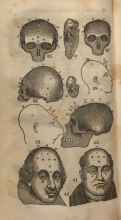
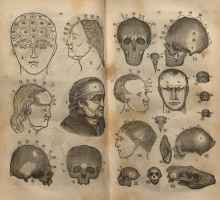
This image provides multiple illustrations of skulls and famous busts, providing measurements for each by which organ size can be determined. Note especially the famous political figures, as well as the attention paid to notorious criminals.
The mapped head was associated with phrenology from its earliest publications throughout the nineteenth century. It provided a useful map of the locations on the skull discussed in phrenological tracts.
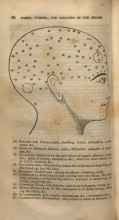
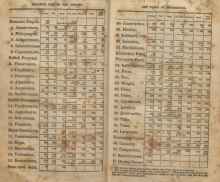
This chart provides the "average," "full," "large," "very large," "moderate," "small," and "very small" sizes of the organs measured in each phrenological category.
Phrenology is important to list here not only because of its publication date—so close to that of Cruikshank’s own work—but also because it is characteristic of the larger corpus of phrenological tracts. Spurzheim’s third edition of this book was published in 1825 and was one of five books extracted from a larger work entitled The Phsyiognomical System.