
Charles Townley’s Sculpture Collection
Image Item
Description
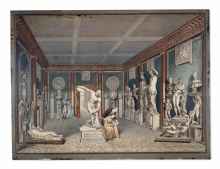
William Chambers’s watercolor depicts the interior of Charles Townley’s dining room, in his home at 7 Park Street, as it appeared in 1794. The focal sculpture is the Discobolus, and flanking it are two reclined sculptures: Endymion on the left, and a drunken faun on the right.
Mr. Greene’s Museum
Image Item

Description
Cook and Stringer’s etching depicts the upper rooms of the Bishops' Registry Office at 12 Sadlers Street, Lichfield, the historic building where the collection of Richard Greene (an apothecary) was held. As Rev.
Inside Out: Representing the Romantic Museum
Curators
Date Published:
Description
This exhibition examines how museum spaces were conceptualized and visually represented in two-dimensional media forms, drawing examples principally from metropolitan London. Many of the museums of the late eighteenth and early nineteenth century no longer exist. However, prints and paintings, often reproduced in gallery guides, periodicals, and ephemera, are valuable sources of information about the objects that they contained: from oddities and marvels to natural history specimens and revered artworks. Such images also document the arrangement of objects and the display strategies employed by collectors and museums, as well as the visual idioms—and aesthetic categories—they used to capture and ‘frame’ their interiors.
Sir Ashton Lever’s Holophusicon
Image Item
Description
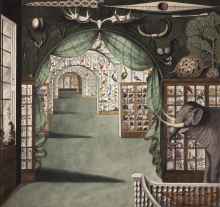
This watercolor, copied ca. 1835 from Sarah Stone’s original—made on site in 1786—depicts Sir Ashton Lever’s museum, or “Holophusicon.” Making effective use of one-point perspective, the drawing depicts the long series of rooms comprising the upper floor of the museum.