
Balloon Dancer
Image Item

Description
This is a satirical illustration of a ballet dancer with a hot air balloon attached to himself which, according to Mayhew, would help the dancer “achieve greater heights.” The facing page exhibits the way a personal balloon might be useful in during accidents.
Grave par Beauble
Image Item
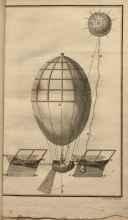
Description
This image highlights the efforts of early experimenters to find ways to develop balloons that could be steered through the air as part of a concerted effort to demonstrate the usefulness of balloons. It offered readers a glimpse of new ideas about balloon navigation using a rudder and paddle-wheels.
Cavallo's Plate II
Image Item

Description
This book and image are part of Cavallo's work on the study of air and it properties. This image offered readers a chance to understand the technical side of balloon flights by providing a detailed account of how they were inflated.
The Art of Lying Burlesqued in an Account of A Wonderful Flight or Journey from France to Gibraltar, America, &c. Related by an Eminent Author
Image Item
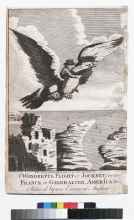
Description
This image, which presented viewers with the image of a boy riding an enormous eagle high above a sea coast, above the title “The Art of Lying Burlesqued in an Account of A Wonderful Flight or Journey from France to Gibraltar, America, &c.
Moonlight, Uxmal Ruins
Image Item

Description
This lithograph depicts a portion of the ruins of Uxmal.
The Pyramid, Uxmal Ruins
Image Item
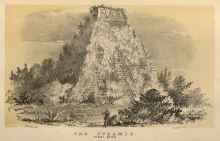
Description
This lithograph depicts a portion of the ruins of Uxmal.
A single large pyramid stands covered in vegetation, crowned by a small, exposed temple. The pyramid is surrounded by a variety of trees and bushes, and is fronted by a small clearing. Two men stand in the center foreground, one gazing up at the pyramid while the other kneels beside him.
Governor's House, Uxmal Ruins
Image Item
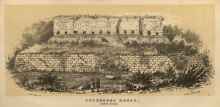
Description
This lithograph depicts a portion of the ruins of Uxmal.
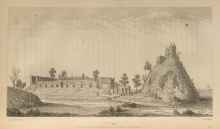
Uxmal: House of the Dwarf and House of the Nuns
Image Item
Description
This image—rendered using a camera lucida—depicts ruins of the city of Uxmal in Mexico.
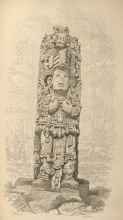
Stone Idol, front view (from Copán)
Image Item
Description
This image—rendered using a camera lucida—depicts a monument from the pre-Columbian Maya city, Xukpi, now known as Copán.
A large stone stela, facing forward, depicts a Maya deity decorated with myriad visual embellishments, its fists clenched upon its chest. The background depicts the small clearing in which the stela now stands, fading back into a thick forest.