Home
Toggle menu
  • Home
  • Editions
    • Latest
    • Explore
  • Praxis
    • Latest
    • Explore
  • Gallery
    • Explore Latest Exhibits
    • Explore Past Exhibits
    • Explore All Images
  • Resources
    • Index of Authors
    • Booklists
    • Syllabus Repository
    • Timelines
  • About
    • Masthead
    • History
    • Index of Contributors
    • Submissions, Use & Citation Guidelines
    • Archived Material

Views of Parts of the Coast of North West America; Point Grenville

Image Item
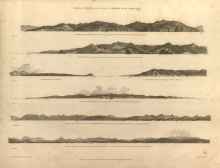
Views of various parts of the northwest American coast
Description

The primary subject of this sheet of coastal profiles is the northwest American coast, fragments of which it presents as synecdoches for the whole. Before James Cook's voyages of discovery, naval draughtsmen created coastal, island, or harbour profiles only in broad outline, primarily as an aid to navigation (Richardson 69).
  • Read more about Views of Parts of the Coast of North West America; Point Grenville

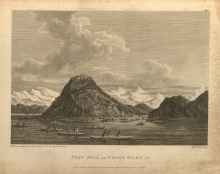
Port Dick near Cook’s Inlet

Image Item
Canoers paddle in front of a mountainous landscape
Description

“Port Dick, near Cook’s Inlet” [or “Port Dick, with a fleet of Indian canoes,” as it is described in “A List of the Plates”] is taken from the third volume of George Vancouver’s A Voyage of Discovery to the North Pacific Ocean and Round the World (1798), where it faces page 150. Drawn by William Alexander from an original sketch by H.

  • Read more about Port Dick near Cook’s Inlet

Innovations in Encompassing Large Scenes

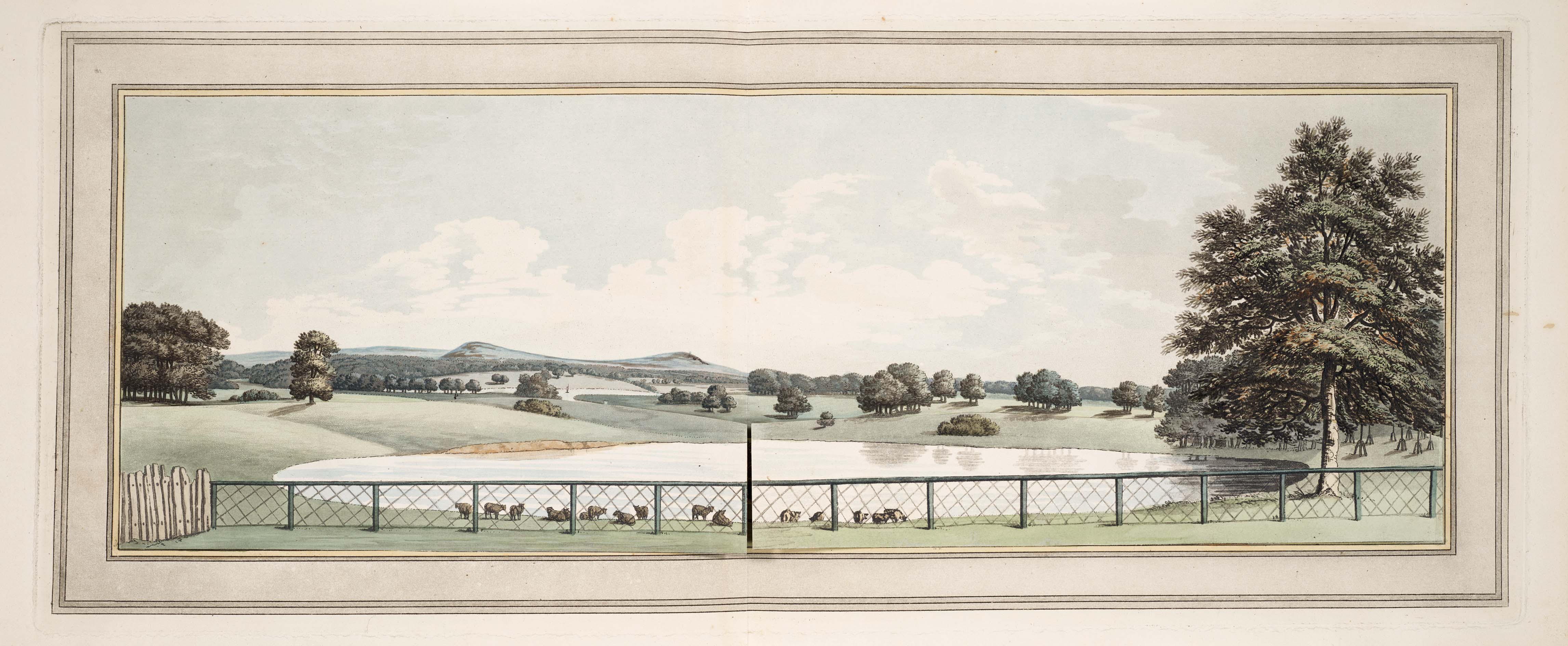
A panoramic scene of the countryside
Curators
Peter Otto
Abigail H. Nedeau-Owen
Date Published:
August 2009
Description

In late-18th and early-19th century Britain, popular interest in "scenes" that exceed or lie beyond the everyday world was heightened by factors such as the emergence of London as Europe's first world-city; James Cook's and George Vancouver's voyages of discovery, which completed in outline the modern map of the globe; and improvements in transport and communication technologies, which brought the distant into the orbit of the near. The consequent appetite for large scenes, evident in the cult of the sublime, was met in part by new virtual-reality technologies—most notably the Eidophusikon, Panorama, Moving Panorama, and Diorama—and an entertainment industry based on them.

  • Read more about Innovations in Encompassing Large Scenes

Reading Text of "Excursion up Scawfell Pike"

  • Read more about Reading Text of "Excursion up Scawfell Pike"


(1)

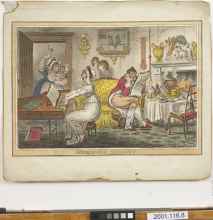
Matrimonial--Harmonics

Image Item
A loud living room scene
Description

This image depicts the failure of harmony in the marriage previously represented (in its partner print) as a harmonious courtship. Harmony is used as a visual pun in each print to convey first, the appealing fantasy of romance, and then the harsh reality of a marriage originating in such a fantasy.

  • Read more about Matrimonial--Harmonics

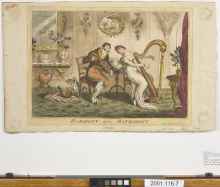
Harmony Before Matrimony

Image Item
A young couple play musical instruments together
Description

This image depicts courtship as typically conceived by the Romantic imagination, as a moment of finding or establishing figurative harmony; such a moment or situation was dependent on the prior, elegant education of young ladies in certain, socially-mediating arts.

  • Read more about Harmony Before Matrimony

Physiological Disquisitions, Plate IV

Image Item
A diagram depicting an Aeolian harp
Description

This image visually depicts the working of sound using the Aeolian harp—an instrument significant to the Romantic imagination—as the primary model. The engraving also includes several scientific diagrams indicating how the harp might function.

  • Read more about Physiological Disquisitions, Plate IV

Treatise on Sound, Plate 3

Image Item
A diagram depicting "vibrations in solid bodies"
Description

This scientific diagrams depicts "vibrations in solid bodies," including rods and plates. In the image, Herschel presents readers with another set of experiments that helps them conceptualize the movement of sound through space, again depending on the visual. Figures 36-41 involve the vibrations of a rod either resting against a wall or free.

  • Read more about Treatise on Sound, Plate 3

Outlines of Experiments and Inquiries Respecting Sound and Light, Plate VII

Image Item
A diagram explaining octave and variant systems of tuning
Description

This image depicts an octave as rendered differently by each temperament. Young particularly emphasizes circumference Y, which represents the system that Young found most effective: twelve-tone equal temperament. The image depicts an octave and variant systems of tuning, or "temperament." The octave is represented by the circumference of the circle.

  • Read more about Outlines of Experiments and Inquiries Respecting Sound and Light, Plate VII

Outlines of Experiments and Inquiries Respecting Sound and Light, Plate VI

Image Item
A diagram explaining various properties of sound
Description

Using mathematical techniques, this image visually depicts aural phenomena: the sound waves produced by playing an octave. The image uses scientific diagrams to depict sound waves and vibrational patterns. The specific phenomena depicted by the various figures and the import of these depictions are discussed at length below.

  • Read more about Outlines of Experiments and Inquiries Respecting Sound and Light, Plate VI

Pagination

  • First page « First
  • Previous page ‹ Previous
  • …
  • Page 88002
  • Page 88003
  • Page 88004
  • Page 88005
  • Current page 88006
  • Page 88007
  • Page 88008
  • Page 88009
  • Page 88010
  • …
  • Next page Next ›
  • Last page Last »
Subscribe to


Masthead

About

Contact Us

sfy39587stp18