
Editor’s note: The Kenyon Transcript
Editor’s note: The Kenyon Transcript
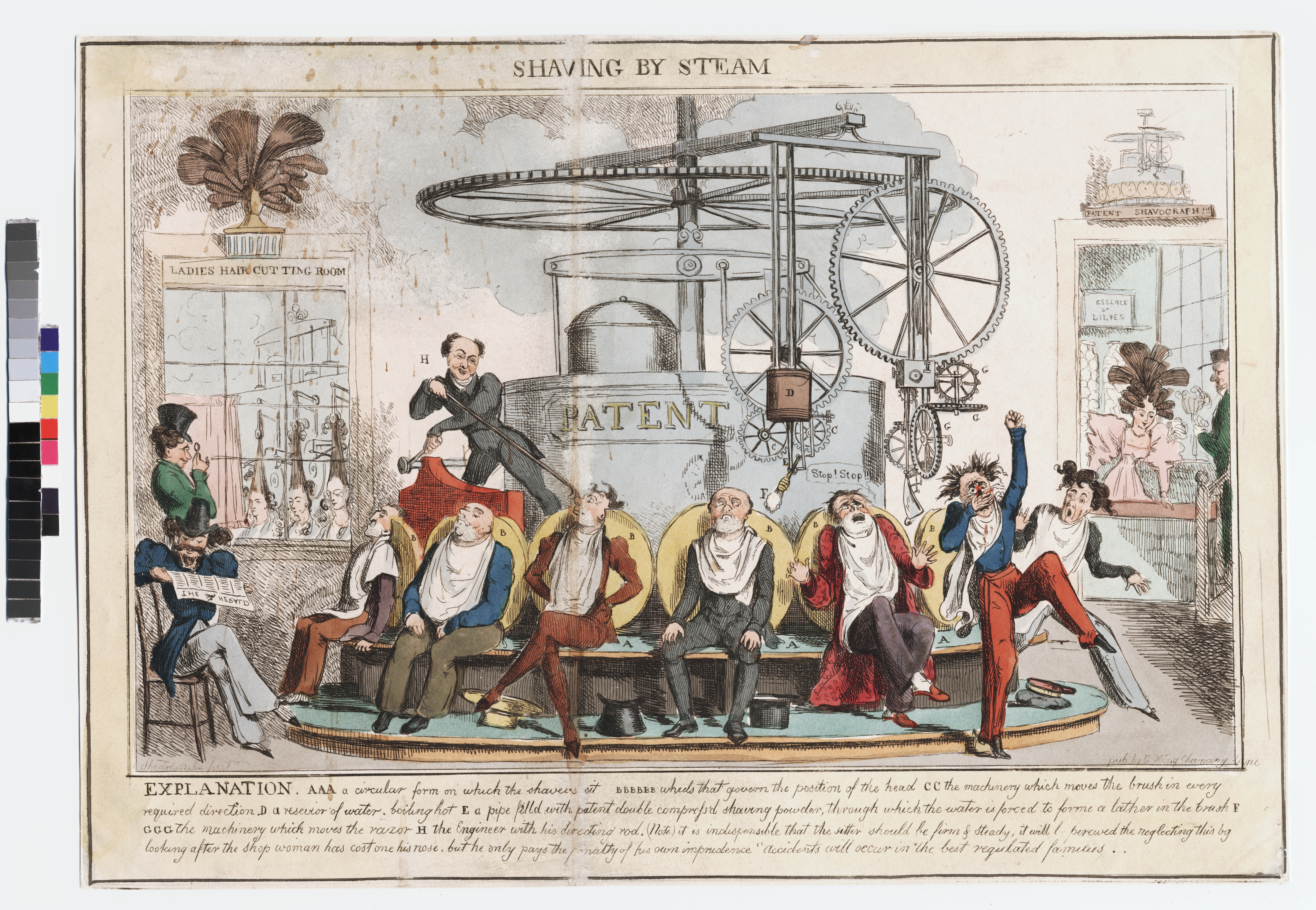
Though automata have existed since antiquity, the proliferation, sophistication, and spectacle of eighteenth and nineteenth-century automata have been of particular interest for writers, scientists, philosophers, historians, and literary critics both during the Romantic period and today.

When assessed with its partner print "Harmony before Matrimony," this print entertained viewers with a comic rendering of the loss of courtship-induced naïveté to painful marital discord.

A viscountess sits between a portrait of a peasant woman breastfeeding a baby, the frame of which reads “Maternal Love," and a window revealing a carriage waiting outside, its attendant holding its door open. The viscountess wears a loosely fitting polka-dot dress and a large feather headpiece.

Dressed as nursemaids with patriotic ribbons, Prime Minister Henry Addington, Lord Hawkesbury, and Charles Fox gather around Britannia as an oversized baby squeezed into a crib, the top of which reads “Requiescat in Peace.” In the crib, Britannia sucks her thumb and rests her head on her arm, her shield and scepter lying on her blanket.

Sitting atop a chest inscribed “Bank of England,” a wrinkled and thin woman dressed in paper one- pound notes throws her hands back as Prime Minister William Pitt (the Younger) reaches into her pocket with his left hand and wraps his right arm around her waste, his legs bent as he thrusts his upper body forward and his face into hers.

This print has a twofold purpose: to entertain the public with a scene from the life of highly viewed figures: royalty and actresses or courtesans together provided a double-delight. It also comments on the moral repercussions of inverting gender roles.

Lady Archer and Lady Buckinghamshire, chained at the Pillory, are being battered with eggs and mud by an undefined crowd that disappears into the foreground of the print. Both women don large feather headpieces, heavy gold earrings, and swell-dresses. Buckinghamshire is clearly the shorter and wider of the two.
Patience on a Monument is a social caricature that made use of traditional romantic aesthetic preferences to mock the presumptions of "high" style. It also chastised its highly public victim, Lady Cecilia Johnstone, and in doing so warned the public of following her example.