n098
I.e., Thomas West. Wordsworth once again quotes West’s Antiquities of Furness (1774), as he clarifies two pages later. This is by far the longest direct quotation
in the Guide, further suggesting Wordsworth’s regard for West.
I.e., Thomas West. Wordsworth once again quotes West’s Antiquities of Furness (1774), as he clarifies two pages later. This is by far the longest direct quotation
in the Guide, further suggesting Wordsworth’s regard for West.
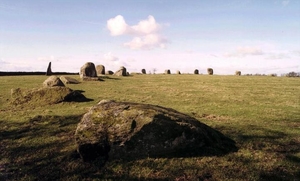
From Wordsworth’s sonnet, “The Monument Commonly Called Long Meg and her Daughter,
near the River Eden,” composed 1821 and first published in A Description of the Scenery of the Lakes (the first stand-alone edition of the Guide and the third edition overall, 1822). A revised version later appeared in Yarrow Revisited as one of the 1833 itinerary poems.
The friend is Thomas Wilkinson of Yanwath, a local antiquary. See Owen and Smyser
for more details on Wilkinson and the story Wordsworth tells here.
Wordsworth quotes from Thomas West’s The Antiquities of Furness (1774).
John Brown (1715-1766). Praising him as “the first who led the way to a worthy admiration
of this country,” Wordsworth probably recalls Brown’s A Description of the Lake at Keswick (1767), a book mentioned by name later in the Guide. Brown’s “Now Sunk the Sun” first appeared in Richard Cumberland’s Odes (1776) and was reprinted in West’s Guide, editions 2–11, where Wordsworth may have encountered it (Wu, Wordsworth’s Reading, 1770–1799, 19). The poem also appeared in various contemporary anthologies, identified as a
“rhapsody” inspired by the Westmorland lakes.
Wordsworth alludes to the opening chapter of Samuel Johnson’s The History of Rasselas, Prince of Abyssinia (1759): “The place which the wisdom or policy of antiquity had destined for the residence
of the Abyssinian princes was a spacious valley…surrounded on every side by mountains,
of which the summits overhang the middle part. The only passage by which it could
be entered was a cavern that passed under a rock.”
Paradise Lost, IV.606-07.
The poet is George Buchanan (1506–1582), the poem “Calendae Maiae.” De Selincourt
gives the Latin lines and supplies this translation from Peter Hume Brown’s 1890 Buchanan
biography: