
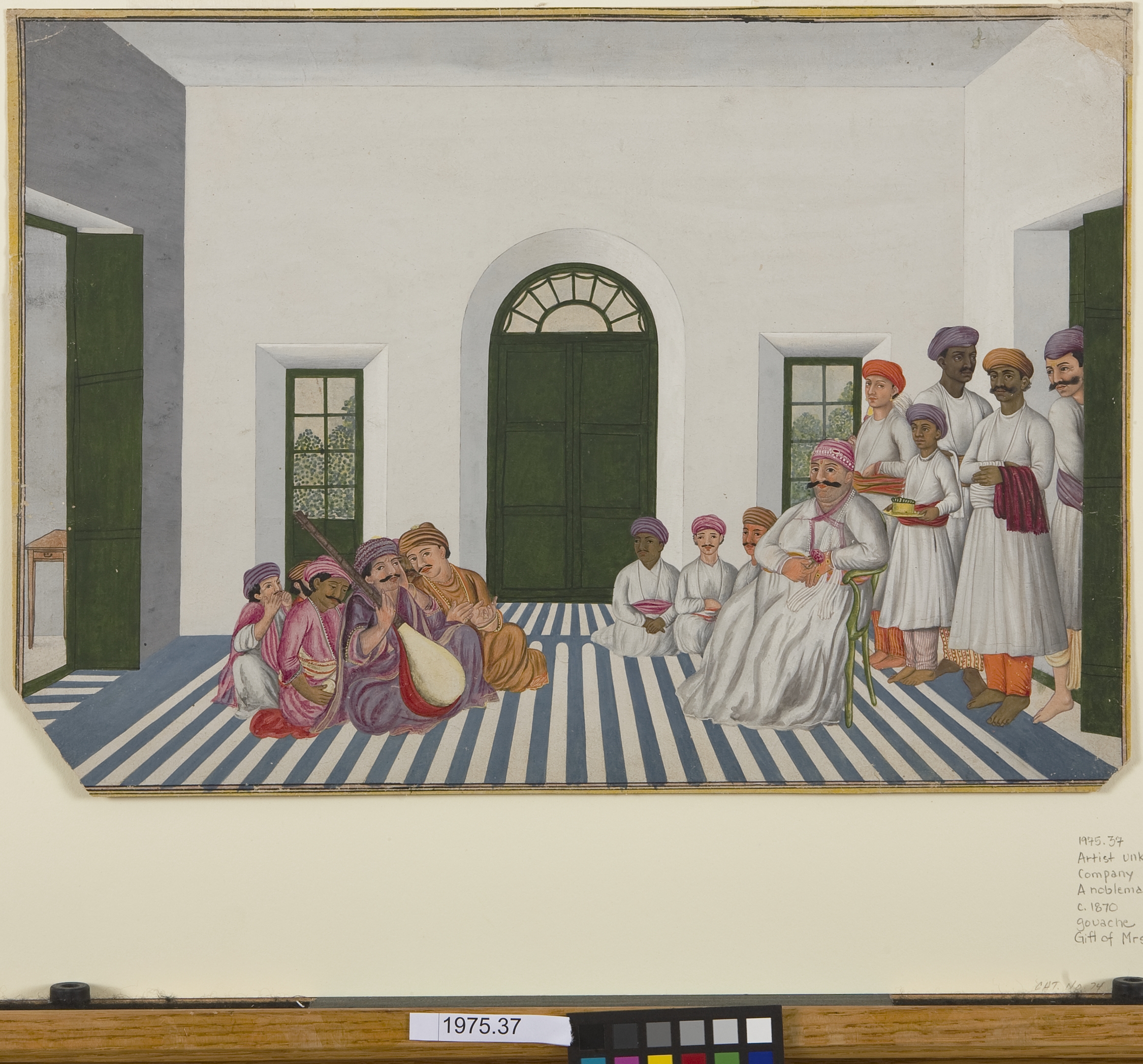
A Nobleman Listening to Music
Image Item
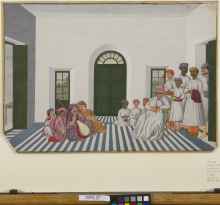
Description
The art historian Pramod Chandra describes this miniature as follows:
The art historian Pramod Chandra describes this miniature as follows:
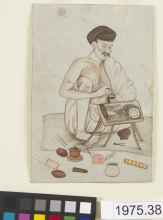
The art historian Pramod Chandra describes the subject of this image as follows:
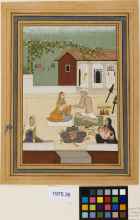
Art historian Pramod Chandra describes this scene:
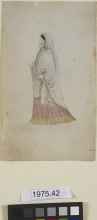
In the catalogue Indian Miniature Painting, Chandra describes Portrait of a Lady: “The lady wears a pink skirt and a white robe. She is sensitively drawn, the linear rhythms, clearly derived from the Pahari style, being readily apparent in spite of the overlay of fussier technique.” (Chandra 50).
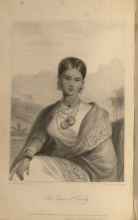
The Queen of Candy, the Candian king’s daughter, poses in a chair, legs crossed, against a mountainous landscape. Her elongated neck is covered with exotic, shell-like jewelry. Her hair is bound tightly back and garnished with a loop of flowers. She averts her gaze from the viewer and modestly covers her shoulders, exposing only one, small hand.
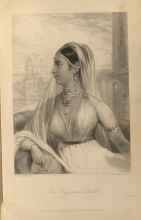
Similar to the central figure of A Hindoo Female, the subject of The Rajpootnee Bride is initially striking on account her size; the female body fills the space of the image. The image is not a portrait of a specific person, but instead gives a generic portrayal of a Rajput bride.
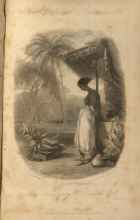
In this engraving, William Daniell draws on different elements of Indian mythology—accounts of holy banyan trees as well as images of yakshi, goddesses closely associated with the fertility of nature—to portray a woman fruit seller as occupying a potential site of sancitity.
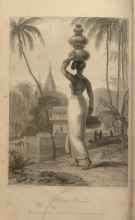
In this engraving, which depicts a woman in relief against distant temple spires, William Daniell combines techniques of the picturesque with elements of erotic Indian art to produce an image that is at once a site of the sacred and of the profane.
During the Romantic period, India was one of Britain’s most prized colonies. From the establishment of the East India Trading Company in 1600 to the mid-nineteenth century, these two cultures were inextricably entwined as a result of the exchange of goods such as textiles, spices and crafts; this initially commercial exchange eventually facilitated and occurred alongside the exchange of ideas and people. This gallery is made up of images of India drawn by William Daniell and bound in his book, The Oriental Annual (London, 1834-40), and also includes miniature paintings done by Indian artists working in the Company style.

Dido in Despair! relays to the public the scandalous pregnancy of Lady Emma Hamilton by Admiral Horatio Nelson in a comical critique of the national figures' sexual licentiousness in general. It also makes a statement about the prominent definition of “high aesthetics” in romantic-era painting.