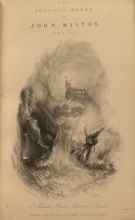
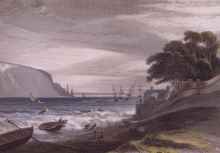
St Michael’s Mount Shipwreck of Lycidas / The Death of Lycidas—Vision on the Guarded Mount
This vignette of the Lycidas sinking off the coast of England illustrates the connection made between the sea and other worlds.
William Daniell's hand-colored aquatint illustrates the difficulty of maintaining control of the sea once it had been, in a sense, claimed by Britain's perception of itself as a great maritime power. This difficulty is mirrored in the struggle of the men attempting to haul a rowboat ashore and in the labored leaning of the distant vessels against the storm.
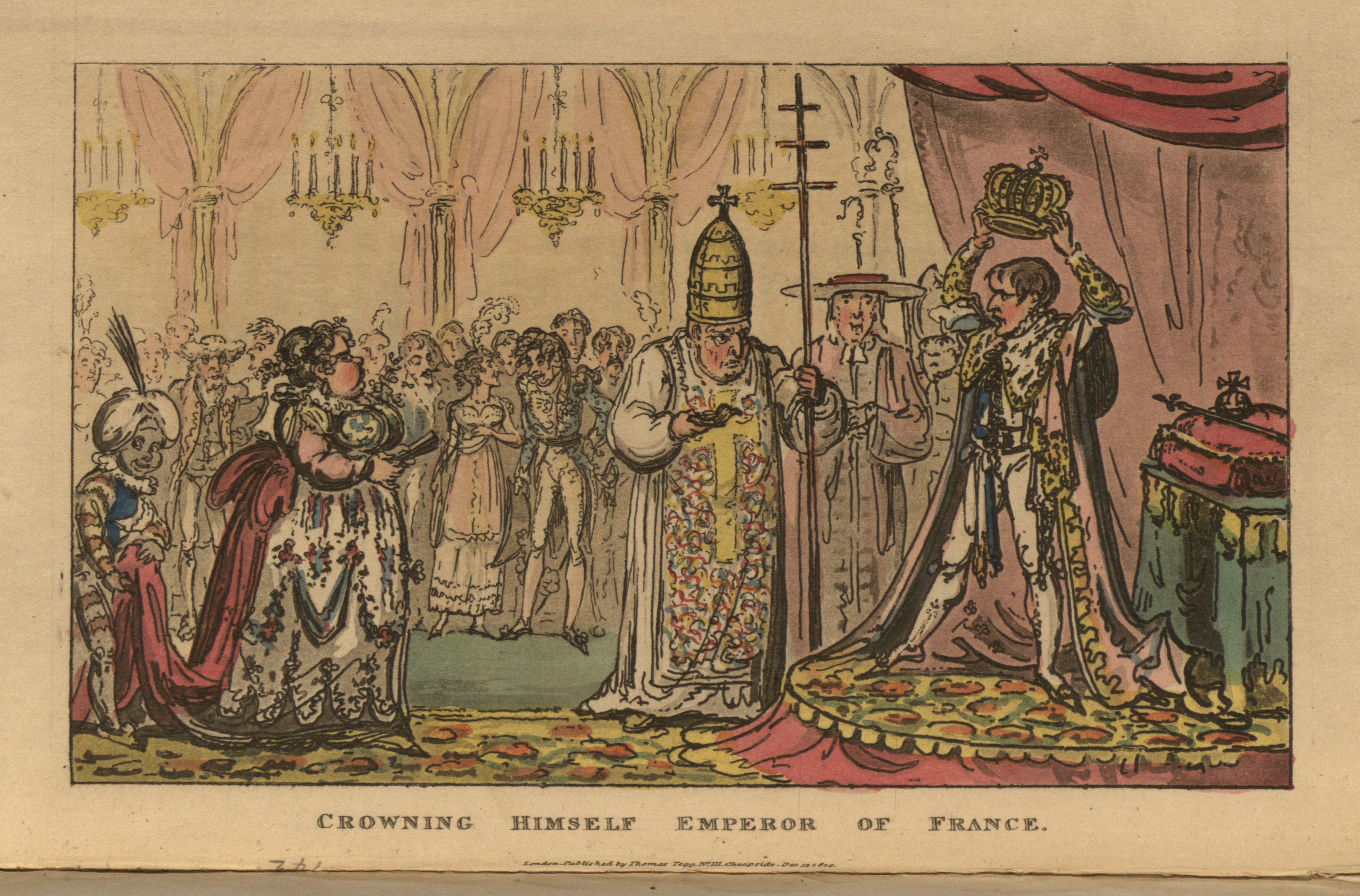
George Cruikshank (1792-1878), who began his long and influential career as a caricaturist and book illustrator at the age of eight, working in his father’s shop, produced a steady output of political prints for over sixty years, although he focus had shifted to book illustration by the mid 1820’s. His works, which include more than 6000 graphic designs, ranged from portraits (some satiric, others not, depending on the tastes of his patrons and employers), attacks on politicians, the British monarchy, and Napoleon, illustrations for children’s books, and advertising for the Temperance Movement. By the second decade of the nineteenth century he was admired as the leading British caricaturist.

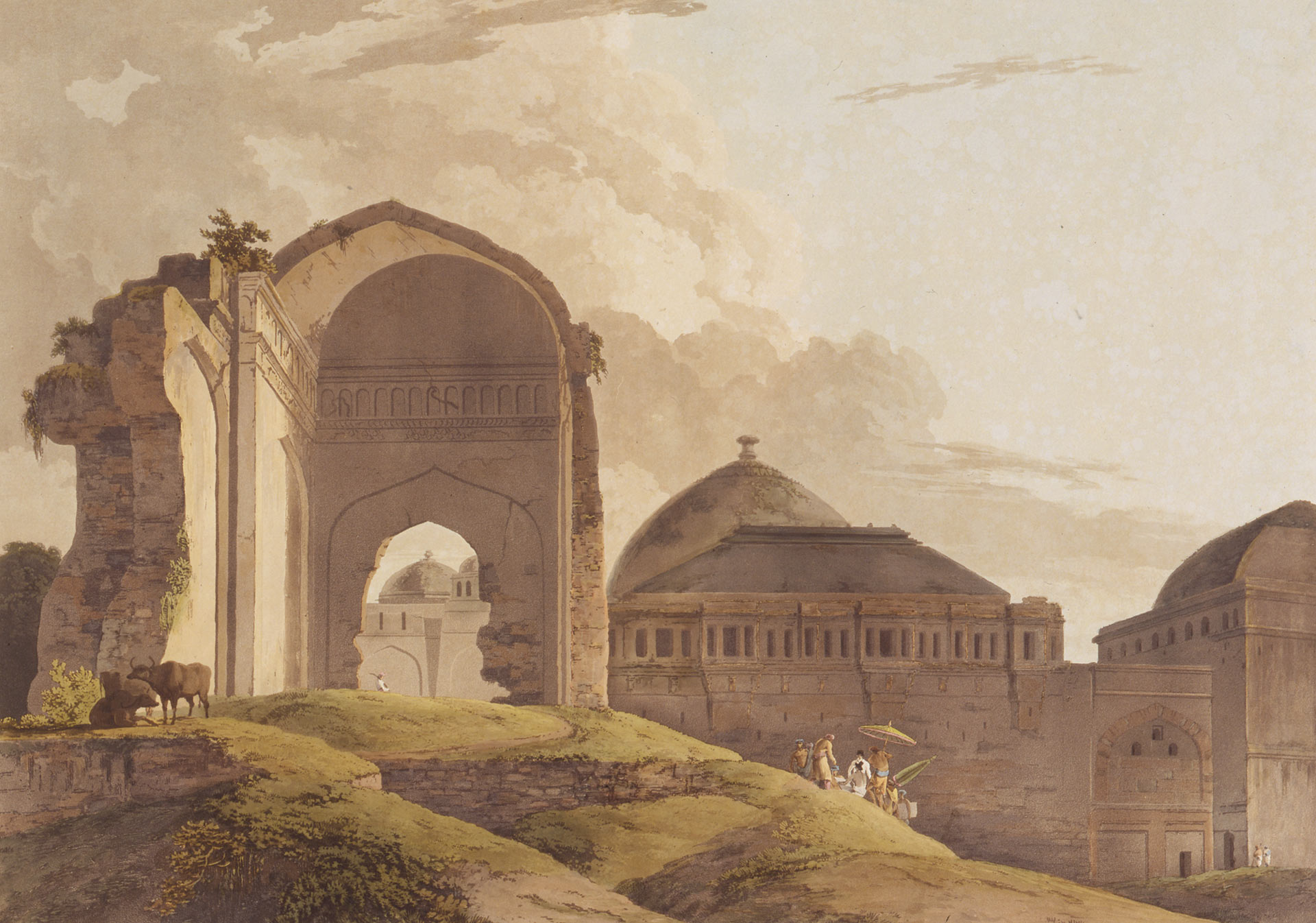
The choice of subject in this piece, a crumbling medieval monastery situated on the border between Scotland and England, can be interpreted as a temporally and spatially liminal place; the presence of the ruins collapses not only the present and the past, but also the national identities of the English and the Scottish.
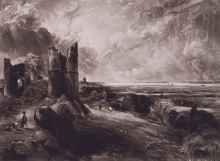
This image depicts the ruins of Hadleigh Castle, near Leigh-on-Sea, Essex. The two remaining towers of the castle stand in the left register of the picture place, a scrawny tree between them. In the lower left corner, a shepherd boy carrying a staff is walking up the incline toward the ruins. A dog follows close behind him, looking up at the sky.
During the Romantic era, tourism—and picturesque tourism, in particular—gained popularity across the Continent. While William Gilpin’s enormously popular British domestic tours were circulating in the 1780s and 1790s, an intense debate about the nature of the picturesque was being waged, partly in response to Gilpin’s “authoritative judgements” on the topic (see Stephen Copley's essay "Gilpin on the Wye: Tourists, Tintern Abbey, and the Picturesque" in , ed. Michael Rosenthal, et. al, New Haven: Yale UP, 1997; 133).
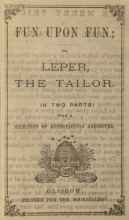
A beehive sits atop a thick board, with wild-looking plants growing on either side. Grass grows around the hive's board. Seven bees hover around the top of the hive, with another at the hive's center. The board bears the word "industry"; below the grass, a banner with forked ends reads "honesty and integrity."
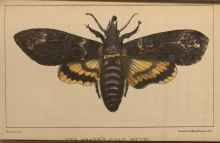
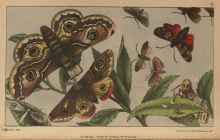
This image depicts a death's-head moth on a white background, with wings outstretched.
In its vivid but stark depiction of a death's head moth, this illustration indicates the influence of Rousseau's thought on children's education: rather than relying on associationism, Rousseau's ideal education resisted the collaboration of fact and fantasy as potentially harmful.
In this image, the fantastical and the scientific are combined to make the subject matter of the accompanying text more appealing to a young audience.