Retreat from Moscow
Image Item
Description
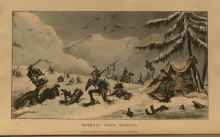
This image depicts the retreat of Napoleon and his forces from Moscow, with particular emphasis on the harsh and nightmarish conditions of their journey.
This image depicts the retreat of Napoleon and his forces from Moscow, with particular emphasis on the harsh and nightmarish conditions of their journey.

This image depicts Napoleon posing majestically as the newly crowned Emperor of France.
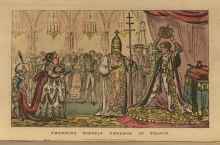
This image depicts the coronation of Napoleon at Notre Dame. Signifying the controversial nature of his rise to power, Napoleon crowns himself rather than being symbolically invested by the collective will of the nation.

Napoleon on his characteristic white horse is at the forefront of this image, which depicts the French army’s early attempt to cross the Alps. Other men, who are both on horseback and on foot, surround him. At the end of the visible portion of the procession are men tugging at something that is not included in the print. Beyond this group of men is a river and the Alps.
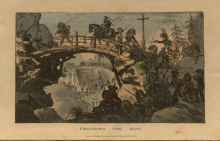
This image primarily depicts Napoleon's attempt to lead the bedraggled French forces across the Italian Alps. More significantly, the image criticizes Napoleon's lust for wealth and power by including the decontextualized figure of the Asian man, who serves as a symbol of the common perception of Asia as a source of capital.
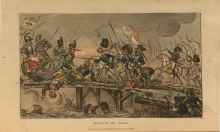
This image depicts the Battle of Lodi, fought by the French forces (led by Napoleon) against the Austrians (Gen. Beaulieu). The French forces, though caricaturized in this image, were victorious.

Napoleon and Josephine pose in the garden of their chateau, Malmaison. The image is a combination of historical accuracy and fictional representation: while Napoleon and Josephine are depicted realistically, their property is represented in much better condition than it actually was.
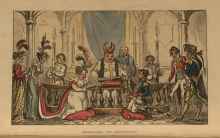
This image depicts the marriage of Napoleon Bonaparte and Josephine de Beauharnais. It is, however, a fictional representation, as Napoleon and Josephine never had a religious ceremony.