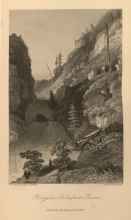
Portage in Hoarfrost River
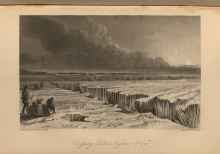
One of Sir George Back's most unusual landscapes, Portage in Hoarfrost River is a vertically-oriented image that depicts several men trying to drag their canoe out of the river and up an extremely steep incline.
With its sweeping line of rock, startling juxtaposition of distant landscape with the nearer scene, and diminutive figures wrestling their boats over the "reef," this image is at once a picturesque re-visioning of a landscape and a record of exploration intended to reinforce British imperialist vision and scientific study.
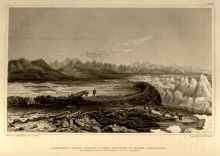
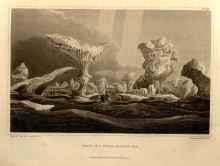
One of two notable images by Sir George Back with a meta-artistic feature (a man sketching in the foreground), "Iceberg Adhering to Icy Reef" depicts the severely difficult landscape of the Canadian Arctic as simultaneously challenging and becalmed. This paradoxical depiction, in turn, suggests the difficulty of portraying such a landscape in an understandable manner.
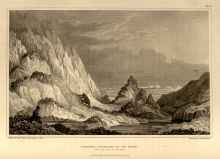
This image is primarily remarkable for its dissimilarity to other images by Sir George Back.
A train of men and sleds navigate an icy crevasse in Lake Aylmer, in the middle of the Arctic night. Sir George Back's depiction of this scene realistically though artistically conveys the trials endured by explorers of the time period, as well as the starkly "other" landscape that the Arctic represented.
Two rowboats fearlessly navigate massive, strangely shaped blocks of ice without any apparent trouble. Such an image, depicting both the threat of untamed nature and the successful human exploration of that nature, results in an uncanny combination of implicit danger and imperialist (as well as pragmatist) confidence.
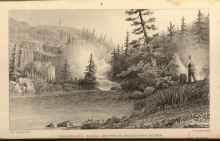
One of Sir George Back's most picturesque images from Narrative of the Arctic Land Expedition, "Beverly's Falls" also subtly challenges that convention with its lowered viewpoint, the realistic scale of its subjects, and Back's sublime-inflected description of the scene in the accompanying narrative.
The artwork of Sir George Back, Royal Navy explorer of the Canadian Arctic, invites our reexamination of the paradigms of Romantic visual culture via its depiction of the “otherness” that the Arctic represented to the British during the eighteenth and nineteenth centuries, as well as the difficulty of physically navigating that landscape. A compelling combination of the picturesque, sublime and “true-to-nature”—a combination sometimes found in just one image—Back’s artwork is almost equally aesthetically and scientifically driven, and as such walks a peculiar line that evades merely imperialist, picturesque, sublime or scientistic tropes.

This intimate domestic scene portrays two lovers who, because of their profound absorption in each other, are simultaneously spectator and spectacle.