n120
Holy of holies.
Holy of holies.
The ruler of the winds in Greek mythology.
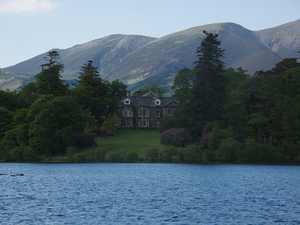
More commonly known as Derwent Isle, this island’s alternate name can be traced to
the era when, prior to the sixteenth-century dissolution of the monasteries, it was
owned by the monks of Fountains Abbey in Yorkshire.
Both the venerable Bede and local tradition hold that the seventh-century anchorite
St. Herbert chose this island on Derwentwater as the site for his hermitage.
This was one of Wordsworth’s favorite passages, as evidenced by how frequently he
quotes it elsewhere in his writings.
Thomas Gray died two years after the 1769 publication of his Tour of the English Lakes. For more on Gray’s Tour, see the introductory essay.
In 1771 Dr. John Brown published A Description of the Lake at Keswick (and the Adjacent Country) in Cumberland: Communicated
in a Letter to a Friend, by a Late Popular Writer. Earlier in the Guide, Wordsworth reprints Brown’s twenty-line “fragment” on the Vale of Keswick in its
entirety. Owen and Smyser note: “In his own day, Dr. John Brown (1715-1766) was best
known for an immensely popular work entitled An Estimate of the Manners and Principles of the Times (London, 1757); after his death, however, he became important among writers on the
Picturesque for his brief, but impressive, description around Keswick.”
See introductory essay on the history of Lake District tourism.