n110
The English school of ornamental gardening is generally associated with Lancelot “Capability”
Brown (1715-1783).
The English school of ornamental gardening is generally associated with Lancelot “Capability”
Brown (1715-1783).
Roughly 1770 (the year of Wordsworth’s birth), as Wordsworth says 60 years in the
1822 and 1835 editions, 50 in 1820, 40 in 1810.
Source unknown. Possibly modeled on Proverbs 27:10: “Thine own friend, and thy father's
friend, forsake not; neither go into thy brother’s house in the day of thy calamity:
for better is a neighbour that is near than a brother far off.”
Wordsworth here echoes Gray’s Elegy Written in a Country Churchyard: “Let not Ambition mock their useful toil, / Their homely joys, and destiny obscure;
/ Nor Grandeur hear with a disdainful smile, / The short and simple annals of the
poor” (29–32). Wordsworth expresses sentiments similar to those presented here in
his Essays Upon Epitaphs (written in 1809 and 1810, at about the same time as the letterpress for Select Views).
The religion (or holiness) of the place. Wordsworth probably expects readers to ingest
this phrase on analogy with “genius loci.” In any case, his primary comparison is
between the ethos of the little churches he has described and the “religion” of local
nature itself.
“The years as they pass plunder us of one thing after another”—a quotation from Horace’s
Epistles, Book II, epistle ii, l. 55.
Presented in various sources during Wordsworth’s lifetime as a fragment of the unfinished
Recluse, these lines are now most commonly known as part of “Home at Grasmere.” They were
composed in 1800 and eventually published as “On Nature’s Invitation do I Come” in
1851. Several subsequent nineteenth-century guidebook writers quoted these lines.
_56Thumb.jpg)
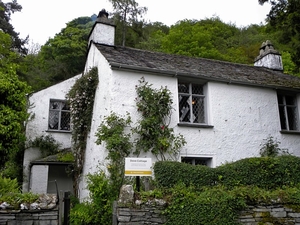
![Wordsworth’s musings recall a report from H.D. Rawnsley’s “Reminiscences of Wordsworth amongst the Peasantry of Westmoreland”: “Wudsworth was a great un for chimleys, had summut to say in the making of a deal of ’em hereabout. There was ’most of all the chimleys Rydal way build after his mind. I ’member he and the Doctor [Thomas Arnold] had great arguments about the chimleys time we was building Foxhow, and Wudsworth sed he liked a bit o’color in ’em….And heèd a great fancy an’ aw for chimleys square up hauf way, and round the t’other. And so we built ’em that how” (qtd. in Wordsworthiana, ed. Knight, 1889, p. 93). Photo of chimney near Grasmere: Paul Westover.](/sites/default/files/imported/editions/guide_lakes/images/Section_Second/Chimney_51Thumb.jpg)