
Recreations in Mathematics and Natural Philosophy, Plate I
Image Item
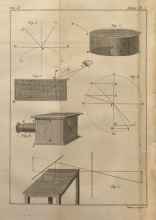
Description
Recreations in Mathematics and Natural Philosophy is an example of the popularization of rational recreations texts in the Romantic period, particularly for use in the home. It explains how to create optical instruments and understand their effects on recreational scientific experiments.
Illustrations of Natural Philosophy, Plate No. 32
Image Item

Description
Illustrations of Natural Philosophy highlights the continued amateur interest in investigations of the natural sciences during the Romantic period. The camera obscura is positioned in the lower right corner, near two illustrations of the human eye, as well as the magic lantern and the “Endless Gallery” optical illusion.
Editorial Philosophies and Guidelines
Romantic-Era Women and the Scholarly Edition
Abbreviations for Commonly Used Names and Sources
Abbreviations for Commonly Used Names
-
Dora — Dorothy Wordsworth, daughter of WW and MW (1804–1847)
-
DW — Dorothy Wordsworth (1755–1855)
-
John — John Wordsworth, eldest son of WW and MW (1803–1875)
-
MW — Mary Wordsworth, née Hutchinson, wife of WW (1770–1859)
-
SH — Sara Hutchinson, sister of MW (1775–1835)
-
STC — Samuel Taylor Coleridge, poet and friend (1772–1834)
Seeing beyond the Dark Room: Representations of the Camera Obscura
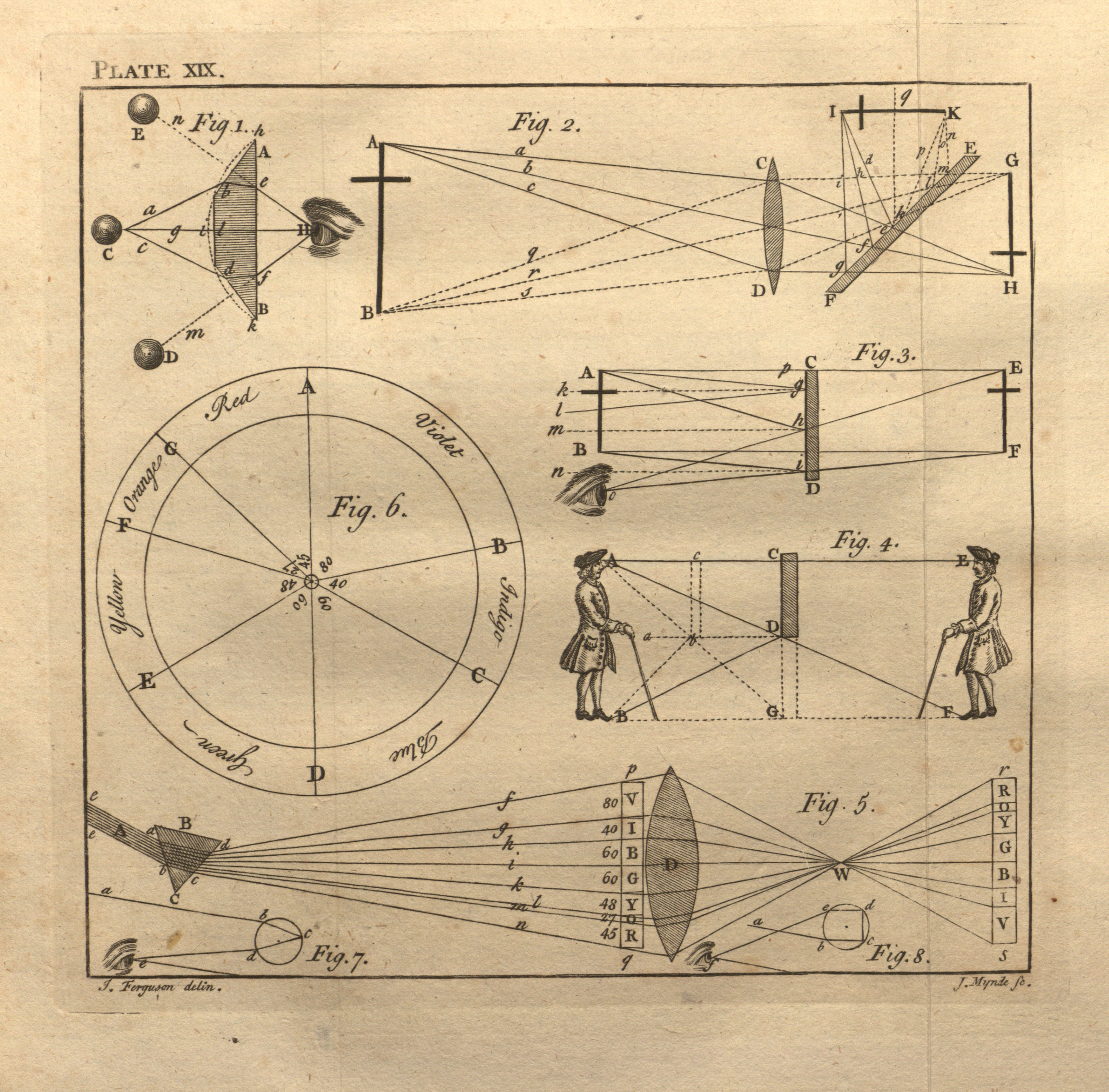
Date Published:
Description
This image gallery explores the unstable place of the camera obscura in Romantic visual culture and offers a critical revision of Jonathan Crary’s central thesis in Techniques of the Observer (1990). In this text, Crary contends that the camera obscura is a model of rational, disembodied vision that is later subsumed by a modern, subjective mode of observation. The varied representations of the optical apparatus in the Romantic period, however, complicate his notion that the camera obscura as a principal model of observation was roundly discarded in the first quarter of the nineteenth century in favor of a conception of modern vision based on new optical technologies.