
Royal Academy - Somerset House, London
Image Item
Description
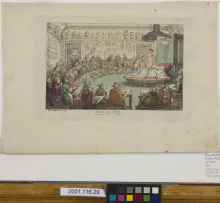
In this image, students of the Royal Academy at Somerset House are trained in the techniques of observing and depicting the female nude.
In this image, students of the Royal Academy at Somerset House are trained in the techniques of observing and depicting the female nude.

Romantic London is a city of spectacles: from Bartholomew Fair to Covent Garden, from the Great Exhibition Hall to the Royal Academy. These spectacles serve as both the location and occasion for a wide range of viewing practices and interactions, as spectators turn their gaze from the stage and exhibit to the boxes and crowds. This gallery seeks to examine the notions of the viewer and the gaze through the crowd scenes afforded by London’s social calendar of cultural spectacles. Focusing on the formation of the art spectator, this gallery traces the various modes of viewing art—from its conception in life-drawing classes to its display at the Royal Academy Exhibition, and finally to its place in the private collection.
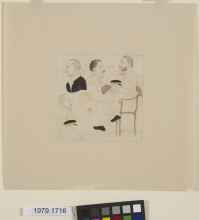
The art historian Pramod Chandra gives a description of Studies of European Figures, quoted below:
[A] study sheet shows four European figures, one of them seated on a chair and three busts. The artist seems to have been trying to acquaint himself with unfamiliar anatomies, and also with the shapes of European caps. (Chandra 65)
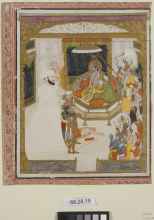
This scene depicts the return of Rama and Sita from exile as narrated in the the Hindu epic, The Ramayana. A recurring theme in this image (found in many Indian works) is the idea of a divine king (chakravartin).
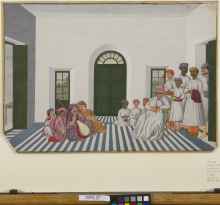
The art historian Pramod Chandra describes this miniature as follows:
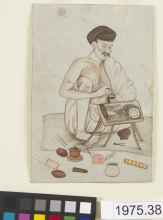
The art historian Pramod Chandra describes the subject of this image as follows:
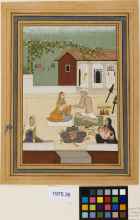
Art historian Pramod Chandra describes this scene:
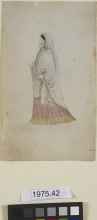
In the catalogue Indian Miniature Painting, Chandra describes Portrait of a Lady: “The lady wears a pink skirt and a white robe. She is sensitively drawn, the linear rhythms, clearly derived from the Pahari style, being readily apparent in spite of the overlay of fussier technique.” (Chandra 50).
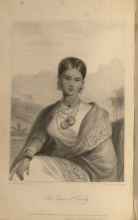
The Queen of Candy, the Candian king’s daughter, poses in a chair, legs crossed, against a mountainous landscape. Her elongated neck is covered with exotic, shell-like jewelry. Her hair is bound tightly back and garnished with a loop of flowers. She averts her gaze from the viewer and modestly covers her shoulders, exposing only one, small hand.
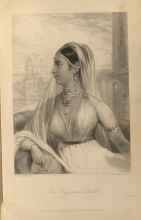
Similar to the central figure of A Hindoo Female, the subject of The Rajpootnee Bride is initially striking on account her size; the female body fills the space of the image. The image is not a portrait of a specific person, but instead gives a generic portrayal of a Rajput bride.