Untitled
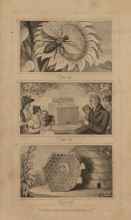
This illustration consists of three images: the top and bottom images ("1" and "3") depict the natural life of bees, while the middle image portrays the dissemination of knowledge concerning the life of the hive.
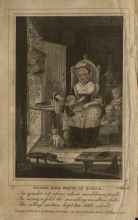
This book illustration depicts Henry Kirke White, one of the text's discussed literary celebrities, as a fragile-looking child; consequently, the image alludes to White's early death and the tragically brief duration of his brilliant and promising career.
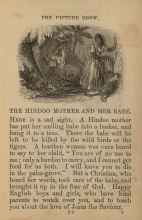
In this image, a Hindu woman abandons her baby in a basket hung from a tree. The illustration serves as a counterexample to the moral lesson of the accompanying text, while also serving as an example of the absence of "Christian" virtue in "pagan" cultures.
While the other illustration from Cobbin's Elements of English Grammar (the first image of the gallery) uses visual figures to personify discussed terms, this image provides a picture of the action described by the accompanying text: that is, the illustration acts as an example, rather than a symbolic representation, of the lesson.
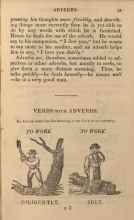
This image serves to visually illustrate and explicate a lesson plan in a grammar book. The accompanying text appears to be a lesson plan regarding verbs and their "properties." The image depicts three figures, each of which represents a different "voice" of verbs.
Though the Victorian period is often considered the Golden Age of childhood, the children’s book market was an active political and moral battleground as early as the 1770s. With Rousseau’s new theories about children and their education challenging the older but well-entrenched philosophy of Locke, children’s books—and, more specifically, their illustrations—became a central issue for those invested in the debate. At the same time, violent riots in favor of Parliamentary reform caused the aristocracy to fear the possibility of a full-scale revolution like that raging in France. This fear made social control more important than ever to the upper-class, from which most authors and publishers came.

This image has as its subject the topography of Rome and its environs—their natural, geographical features, as recorded by Gell's trigonometrical survey; and the artificial environment, as it existed in Classical times.
In the early nineteenth century, the term "moving panorama" could refer to an optical entertainment (both the apparatus itself and the sequence of virtual prospects that it conjured); an unfolding view of an actual scene, whether of landscape, pageant, or streetscape; and "a series of images passing before the mind's eye" (OED).
This image provides a simulation (a linked sequence of picturesque views) of a simulation (the Diorama of Venice) of a tour of the actual City of Venice and its environs.
The fore-edge painting on the first volume of Sir Walter Scott's Kenilworth, probably depicts Kenilworth Castle; and the painting on the third, Cumnor Place; with both buildings pictured in the midst of a vast rural landscape.